
MLK keynote speakers: Creating coalitions is best way forward
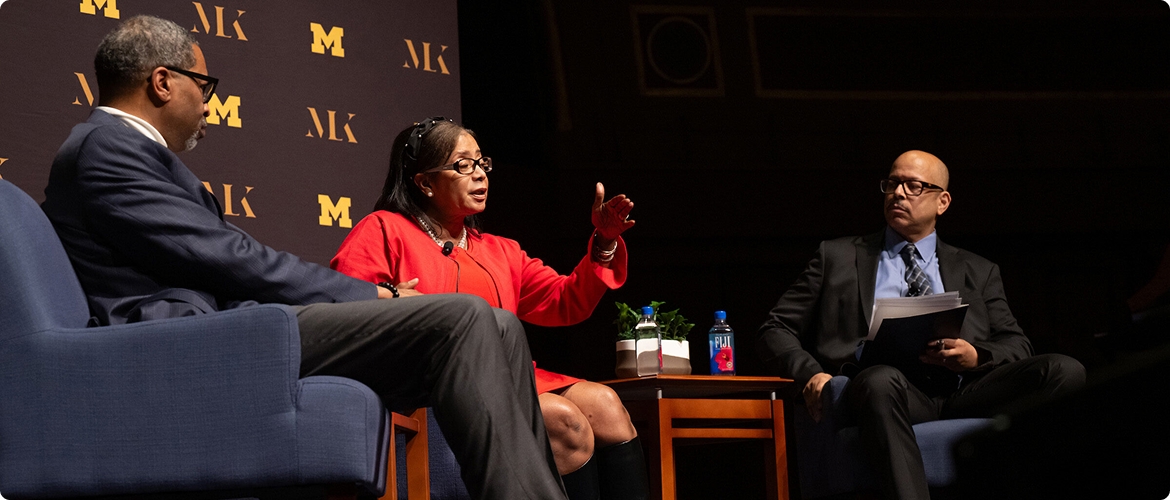
The 40th annual MLK Symposium kicked off Jan. 19 with the Keynote Memorial Lecture, featuring a conversation between Donzaleigh Abernathy, a civil rights activist, actress, writer and the godchild of Martin Luther King Jr., and Derrick Johnson, the 19th president and CEO of the NAACP.
The discussion was moderated by U-M’s Alford A. Young, Jr., University Diversity and Social Transformation Professor; Arthur F. Thurnau Professor; Edgar G. Epps Collegiate Professor of Sociology, professor of Afroamerican and African studies, and associate director of the Center for Social Solutions in LSA; and professor of public policy in the Gerald R Ford School of Public Policy.
The keynote lecture took place at Hill Auditorium and was livestreamed.
U-M’s annual MLK Symposium celebrates King’s life and legacy. In addition to the keynote discussion, this year’s theme, “Unbowed and Unbroken — The Enduring Struggle for Justice” will be explored in events and activities by departments and units across campus.
King often spoke of the struggle for justice as a journey of perseverance. In August 1967, he spoke at a Southern Christian Leadership Conference meeting that was overseen by Ralph Abernathy, father of Donzaleigh, co-founder of the American Civil Rights Movement, and the then-vice president of the SCLC.
During that speech titled “Where Do We Go From Here?” King said, “Before we reach the majestic shores of the promised land, there is a frustrating and bewildering wilderness ahead.”
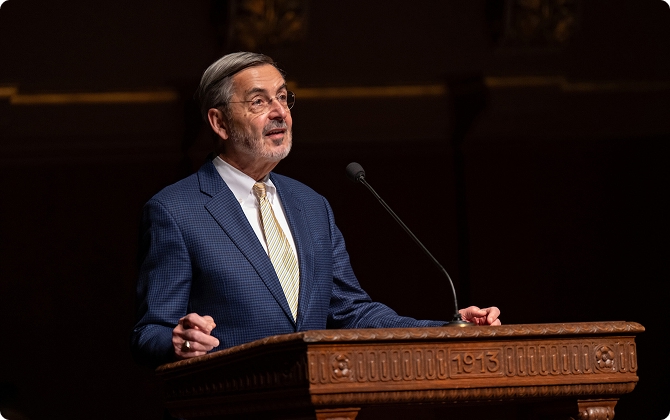
Photo: President Domenico Grasso delivers remarks during the MLK Symposium Memorial Lecture. (Photo by Leisa Thompson, Michigan Photography)
Opening remarks and performances
In welcoming remarks, President Domenico Grasso told the audience that he was a U-M engineering student when the first MLK Symposium was held at the university. Four decades later, the tradition has continued, he said, uninterrupted, even during the pandemic.
Grasso also shared that King had once spoken from the same Hill Auditorium’s historic lectern, telling his audience in 1962, “We must learn to live together as brothers, or we will die together as fools.”
Provost Laurie McCauley echoed the sentiment of finding strength in community.
“To be unbroken is to keep going, to find reserves of strength in community and history when your own feel depleted,” she said. “The struggle for justice has always required both the courage to resist and the stamina to persist. Dr. King lived this.”
“We are all equally beautiful. We need to extend that olive branch to those who are different from us. Sit beside them, help them and love them because love is the greatest force in the universe. And we cannot buy into hate.”
Johnson described a chaotic America that is in a tense relationship with Canada, that’s seeking to take Greenland, that went into Venezuela and removed their head of state without authorization, and that has deployed national guards and Immigration and Custom Enforcement agents to major U.S. cities.
“This isn’t about race. This is about our democracy,” he said.
“If we don’t get past the tool of ‘othering’ that has been so effective in this country to divide us, we’re going to allow a set of individuals with interests that aren’t ours to destroy what we’ve been building for 250 years.”
Young then asked the speakers to explain how to remain unbowed and unbroken in the face of challenges.
Johnson said he’d been trying to draw inspiration from another point in U.S. history but hadn’t found one yet because we’re in uncharted territory. He does, however, remain hopeful about the upcoming mid-term elections — and about the power of coalitions when facing a common challenge.
“We have to endure. And the most important part is how do people who have been conditioned not to work together realize that we have common cause and actually work together,” he said, pointing to his own high school “ethnic club,” where students learned to view their individual differences as strengths that would improve the whole.
Abernathy said being unbowed meant to her “standing with your head up high,” no matter what.
“I’m a Black woman, and Black women, this is the truth, we are the strongest because for more than 244 years, they took our babies and sold them into slavery. And so, your mother and your grandmother and your great-grandmother taught you how to stand strong and not to be afraid, and that’s what’s required of us today. We need to stand together.”
When the discussion turned to how institutions can help support social justice movements, Johnson urged academic institutions like U-M to remain true to their core values.
“There is so much that this university can offer the world, but you can only offer that if you remain true to your mission and don’t suppress the identity of this school for this administration’s comfort,” he said.
At the end of the discussion, Young asked Abernathy and Johnson to speak directly to the young people in the audience about what it means to endure without normalizing suffering.
Johnson said to think of a social justice movement as a road to victory, not as a path paved with hardships. Reframing the effort can help one persist when times are tough.
Abernathy said young people shouldn’t be thinking about suffering — that this part of their life should be enjoyable, and education should be their priority. With that education, she said, they will have the tools they need to face challenges later on — and to help others in their communities.
“All you have to do is read a book, write a paper about it, ingest that material and let it permeate in your brain and in your soul,” she said. “Get that education. And … because you have the benefit of education, you need to go back into the inner city … You all have to be there to help.”
“It takes a village, and you all need to be that village,” she said.
Closing and other contributors
The keynote lecture concluded with a performance by Mama Sōl, a hip-hop and spoken word artist from Flint.
The event also included performances by the Detroit Youth Choir, a rendition of the Black National Anthem by master’s student B’Nathaniel Orlu, a reading of the Land and Labor Acknowledgement by senior Aaron Robinson, and remarks from Angela Dillard, vice provost for undergraduate education, and junior and speaker of the Black Student Coalition Yacine Lo.
U-M’s suspension of classes in observance of the MLK Day holiday, along with the creation of an annual symposium, were direct results of student activism in the late 1980s. Today, the symposium is coordinated by OAMI under the Vice Provost of Access and Opportunity.
View Original Source