
U‑M Hosts National Listening Session to Help Shape a National Museum of Asian Pacific American History and Culture
In recent years, conversations about how the United States tells its story—whose histories are preserved, and how they are interpreted—have taken on renewed urgency. Museums play a central role in that work, serving not only as stewards of the past, but as spaces where public understanding is shaped and expanded.
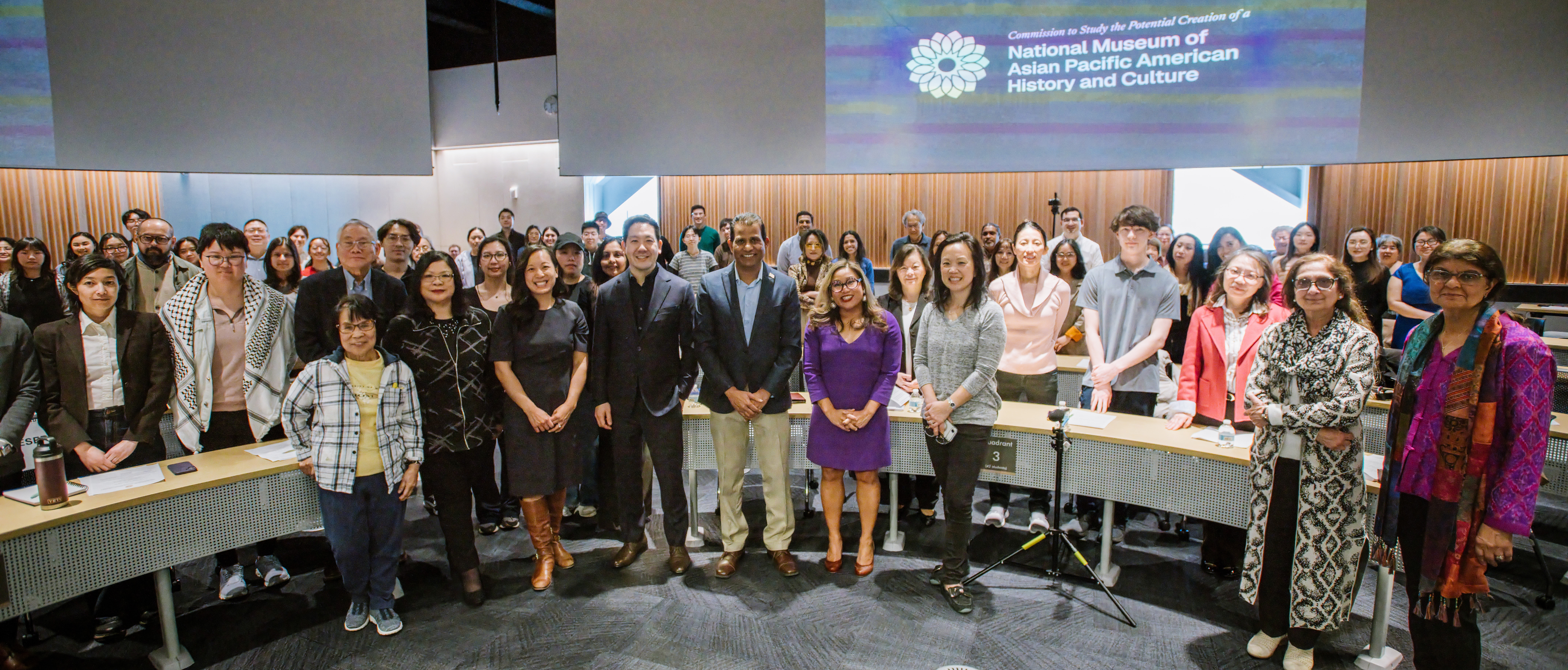
On April 11, 2026, the University of Michigan joined a national, bipartisan effort to advance those conversations. As part of its nationwide listening tour, the Commission to Study the Potential Creation of a National Museum of Asian Pacific American History and Culture convened a regional listening session in Ann Arbor. Co-hosted by the U-M Asian/Pacific Islander American Studies Program, Division of Student Life, Access & Opportunity, Asian, Asian American, and Pacific Islander Alumni Club, and the Museum Studies Program, the session brought together scholars, community leaders, and practitioners to share perspectives on what a future national museum should be and whom it should serve.
Established by Congress with bipartisan support, the Commission is charged with evaluating the feasibility, structure, and funding strategy for a national museum. Its work reflects a shared recognition of the importance of preserving and elevating Asian Pacific Islander American histories as part of the broader American narrative. The Commission will deliver its final recommendations to Congress and the President in October 2026, laying the groundwork for potential authorization.
Participants reflected a wide range of perspectives, including community and business leaders, educators, museum professionals, and students from across Ann Arbor and southeast Michigan. The breadth of voices in the room—spanning generations, sectors, and lived experiences—underscored a central aim of the Commission’s work: to ensure that any future museum is shaped by the communities it seeks to represent.
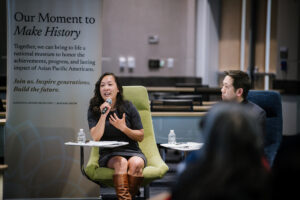
Commission Co-Vice Chair Tina Wei Smith, a University of Michigan alumna whose career spans public service and national policy leadership, led the conversation along with fellow Commissioner Dennis Cheng. Congresswoman Grace Meng (NY), also a U-M alum, who introduced the legislation in 2019, delivered remarks virtually. Meng is the first and only Asian American Member of Congress from New York State, and is currently the chair of the Congressional Asian Pacific American Caucus.
The U-M A/PIA Studies faculty has a decades-long history of scholarship and public engagement focused on documenting, interpreting, and sharing histories that have too often been overlooked. To better understand the significance of the Commission’s visit, and the role of scholarship in shaping this effort, we spoke with Melissa Borja, program director of the Asian/Pacific Islander American Studies Program.
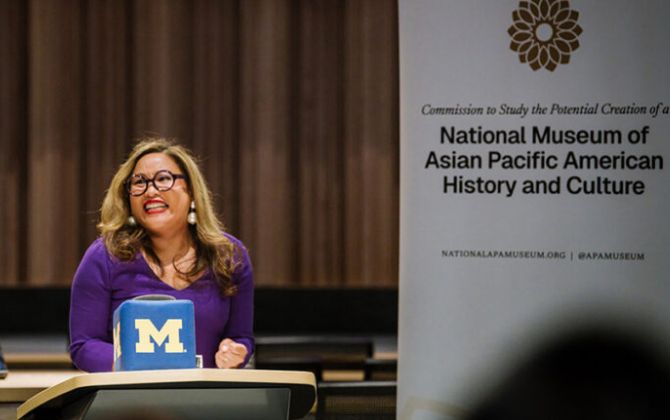
Melissa Borja, program director of the Asian/Pacific Islander American Studies Program.
What is the significance of a national museum dedicated to Asian Pacific American history and culture?
Asian Pacific Islander American history is American history–it’s not peripheral. And an honest telling of our history matters more than ever. How we tell the story of our nation in the past and present shapes how we collectively imagine our future. A national museum dedicated to Asian Pacific Americans will ideally create a space where the public can grapple with our complex histories in truthful, nuanced, and meaningful ways that can, in turn, help us chart a better path forward.
Why are listening sessions like the one held at Michigan important?
The University of Michigan is at its best when it leads through bringing people together. This listening session was a wonderful example of that: gathering both nationally-recognized researchers and valued community members from diverse backgrounds to talk together about what their aspirations and concerns for this museum. That kind of input is essential if the museum is going to reflect the diversity and complexity of Asian Pacific Islander American experiences. The fact that the University of Michigan hosted a listening session also spotlights an important fact: that Asian Americans and Pacific Islanders have formed thriving communities not just on the coasts, but right here in the Midwest!
What role can academic programs like Asian/Pacific Islander American Studies play in this effort?
Programs like ours bring together rigorous scholarship and community engagement. Faculty and students are already working on many of the questions a museum would need to address—about history, public memory, and the importance of truthful narratives in the advancement of creating a more just society. We can help ensure that the museum is grounded in research while remaining responsive to the communities it represents.
What stood out to you about the convening at the University of Michigan?
The event brought so many different people with a wide range of perspectives, all in the same room. You had scholars, community leaders, and U-M students all contributing to a shared conversation. That kind of dialogue–which was enthusiastic while also critical and generative–is exactly what’s needed to shape something as ambitious and important as a national museum.
Conversations like the one we had at U-M are helping to shape a shared vision for a future national museum—one grounded in community insight, informed by scholarly expertise, and committed to telling a more complete and inclusive American story. The convening also underscored the vital role universities can play in advancing that work. By bringing together scholarship, community engagement, and public dialogue, the University of Michigan continues to serve as a site where national conversations take shape—and where the work of understanding and telling the American story moves forward.
By bringing together scholarship, community engagement, and public dialogue, the University of Michigan continues to serve as a site where national conversations take shape.”